Ghana has announced plans to introduce Mandarin Chinese into primary schools nationwide under a new program developed by the National Council for Curriculum and Assessment, marking a significant step in the country’s evolving approach to foreign language education and international cooperation.
The initiative aims to strengthen multilingual learning, promote cultural exchange, and better prepare students for the realities of global engagement. By integrating Mandarin at an early stage, Ghana seeks to equip its next generation with linguistic tools increasingly relevant in diplomacy, trade, technology, and development partnerships.
Education as a Gateway to Global Opportunity
Officials say the program reflects Ghana’s broader strategy to modernize education while aligning curricula with emerging global dynamics. As China continues to expand its economic and infrastructural footprint across Africa, language proficiency is becoming a strategic asset—opening doors to scholarships, professional opportunities, and cross-border collaboration.
Introducing Mandarin in primary education places Ghana among a growing number of African countries embracing multilingualism as a driver of competitiveness in a multipolar world.
Strengthening Ghana–China Cultural Ties
Beyond practical skills, the program is designed to foster mutual understanding between Ghanaian and Chinese cultures. Language learning serves as a bridge—connecting people, reducing barriers, and encouraging dialogue between communities.
For Ghana, this move reinforces decades of cooperation with China across sectors such as infrastructure, energy, education, and trade. For students, it represents early exposure to global citizenship and intercultural awareness.
Balancing Global Engagement and Cultural Identity
While the initiative has been welcomed by advocates of internationalization, it also raises important questions about curriculum balance and the preservation of local languages. Education experts emphasize the importance of ensuring that Ghanaian heritage languages and cultural studies remain central to national education, even as foreign languages expand.
True educational progress, they argue, lies in combining global openness with strong local identity.
Africa’s New Educational Diplomacy
Ghana’s decision reflects a wider continental trend: African nations are increasingly using education as a pillar of diplomacy and development. By diversifying linguistic competencies, countries are positioning youth to navigate complex global networks while attracting international partnerships.
At Afroscopie, we view this initiative as part of Africa’s broader recalibration—where classrooms become gateways to cooperation, and knowledge becomes a tool of sovereignty.
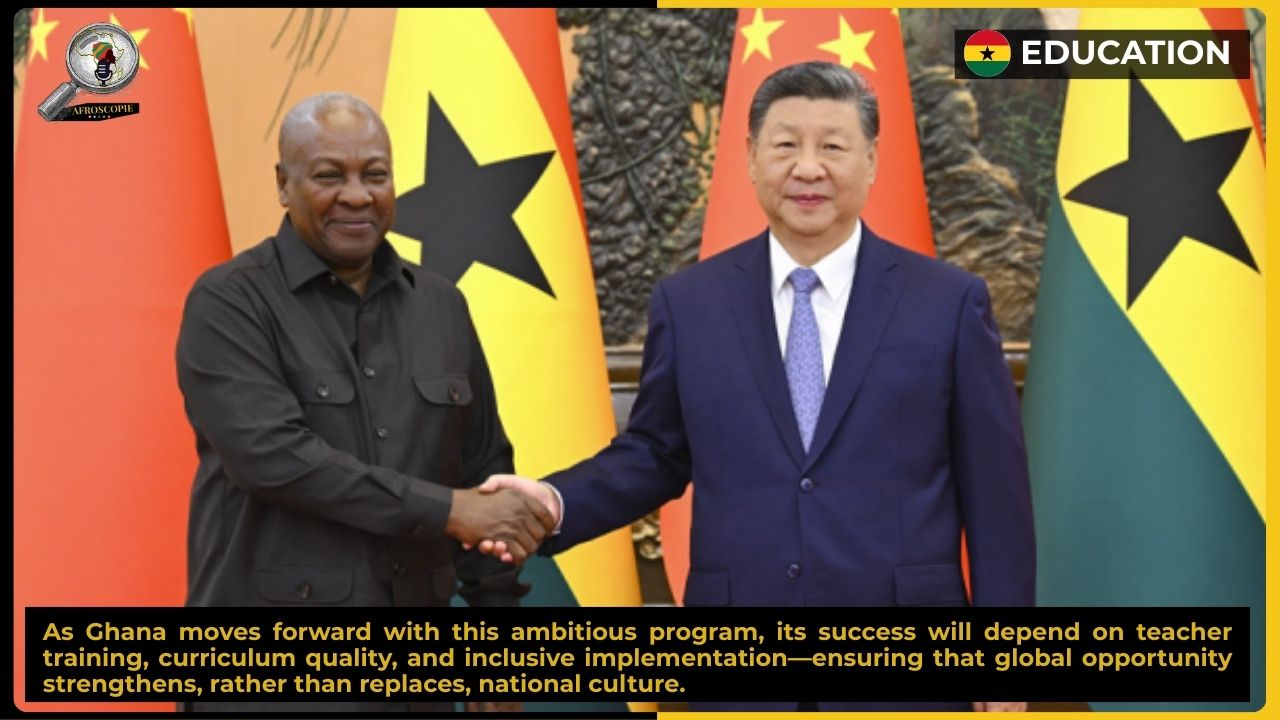
As Ghana moves forward with this ambitious program, its success will depend on teacher training, curriculum quality, and inclusive implementation—ensuring that global opportunity strengthens, rather than replaces, national culture.
By Giscard Ndjogou
Afroscopie News – Education & International Affairs
Tags (SEO):